
State Public Health Experts Continue to Recommend Hepatitis B Vaccination at Birth for All Newborns
postedYou might have heard in the news about a recent change in federal recommendations for the birth dose of hepatitis B vaccination. Let’s talk about what happened and why state public health experts continue to recommend hepatitis B vaccination at birth for all newborns.
The hepatitis B vaccine provides life-saving protection against hepatitis B infection.
Hepatitis B (hep B) is a serious liver infection caused by the hepatitis B virus. Hep B can cause an acute (short-term) illness, with symptoms like fever, fatigue, and nausea. Acute illness can lead to chronic (long-term) illness that can cause liver damage, liver cancer, liver failure, and death. Babies are at very high risk. Nearly 90% of infants born to a parent with hepatitis B develop a chronic infection.
You can prevent hep B infection and its most serious effects, like cancer, by getting yourself and your child vaccinated. Most people who receive the hep B vaccine are immune for life. Early vaccination is an essential step for lifelong liver health.
Universal vaccination at birth has saved lives and prevented thousands of infections.
Universal vaccination makes sure no babies slip through the cracks.
Before 1991, the U.S. followed risk-based recommendations, where mothers who met certain criteria were tested for hep B. But not every mother was tested, some mothers had false negatives, and others contracted hep B after the test but before their child’s birth.
Newborns can contract the hepatitis B virus, even if a parent receives a negative test during pregnancy. Adults and caregivers may have the virus and not know, exposing the infant when in close contact. Nearly 50% of people who have hepatitis B are unaware they have the virus.
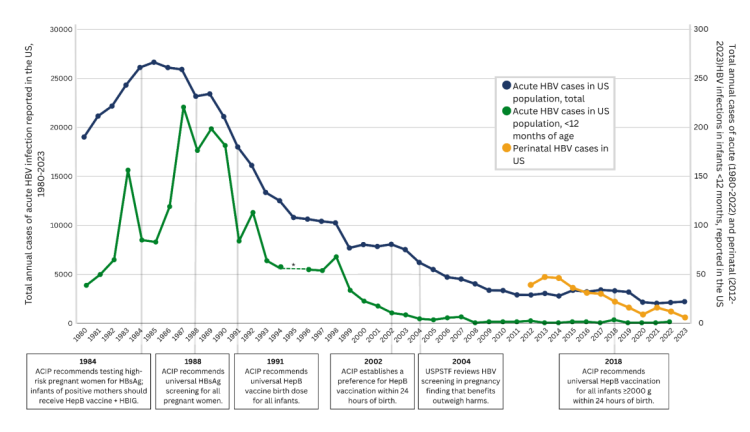
Since 1991, the birth dose has cut pediatric hepatitis B infections by 99%.
To protect babies, in 1991, the CDC recommended universal hep B vaccination of infants at birth. Universal vaccination at birth has saved lives and prevented thousands of infections.
Reported number of acute hepatitis B cases in the United States by year, 1980-2023 and related policy milestones
ACIP recently voted to remove the universal recommendation of hep B vaccination, despite no new evidence of harm, and ignoring the benefits.
No new clinical data, on either safety or effectiveness, were presented by the CDC’s Advisory Committee on Immunization Practices (ACIP) that would justify changes to the longstanding and successful public health practice of universal hepatitis B vaccination. To put it simply: there is no safety, efficacy, or long-term benefit to delaying the birth dose to a later date.
Decades of data continue to support the universal birth dose and the routine 3-dose hepatitis B vaccine series, and the recent ACIP vote did not introduce any new evidence that would change those conclusions.
The Wisconsin Department of Health Services continues to recommend a hepatitis B vaccine dose at birth for all newborns.
After reviewing the available evidence and consulting with clinicians, health system leaders, and public health partners, the Wisconsin Department of Health Services continues to recommend routine administration of the hepatitis B vaccine at birth for all newborns.
Hepatitis B immunizations will continue to be covered at no cost.
- If you have insurance, hep b vaccination at birth is covered for your newborn: Wisconsin statute requires individual and small group health insurers and self-funded governmental health plans to cover hepatitis B immunizations at no cost. Statute requires these plans provide this coverage at birth for a dependent of the person who is insured.
- If you’re on Wisconsin Medicaid, hep b vaccination at birth is covered for your newborn: Medicaid will continue to cover the current hepatitis B vaccine for eligible Medicaid members, including newborns.
- If you don’t have health insurance: We offer the vaccination for your newborn at no cost to you.
This content is free for use with credit to Public Health Madison & Dane County .