
Pools

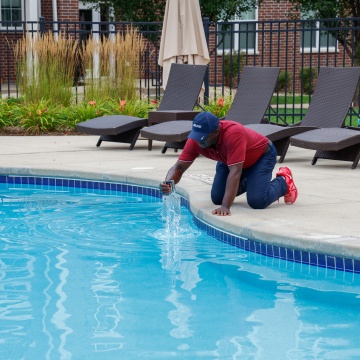
Sanitarian sampling pool water.

We license and inspect over 400 public swimming pools and water attractions to help keep you safe.


Look up a health inspection report

  • These reports give you information on the conditions we saw at the time of inspection.
  • Our reports may not reflect actions the establishment made to correct issues, or the current condition of the pool.

Health inspections


How to get a license for a new pool or change of ownership

To apply for a license for a new pool or when there is a change of ownership:

  1. Check the license fees. Complete a pool license application and send it to the City Clerk’s office with payment. Fees and application must be mailed or paid in person at the Madison City Clerk's Office.
  2. Contact a public health sanitarian at 608-242-6515 or LEadmin@publichealthmdc.com for a pre-inspection before opening to the public.

About your license

  • Licenses are valid each year from July 1 to June 30. Each license we issue expires on June 30. Licenses issued after April 1 will be valid until June 30 of the following year. For example: A license issued on April 1, 2024 will expire on June 30, 2025.
  • You need to renew your license each year. We will mail a renewal to you. You need to return it with your payment before June 30 of each year.

Prerequisites for new pool construction

You need to renew your license each year. We will mail a renewal to you. You need to return it with your payment before June 30 of each year.

We want to better serve you! Fill out our 2-minute anonymous feedback survey about your health inspection.


Safety, maintenance, and operation of public pools, spas, and water attractions

Pool & Spa Disinfection

Disinfection means removing bacteria, parasites and viruses from the water by sanitizing the pool water.  Chlorine is the most common disinfectant used in swimming pools and spas.

Fecal, Vomit, or Blood Incidents

  • You must disinfect when there is a fecal, vomit, or blood accident in the pool water.
  • Close the pool and follow CDC Fecal Incident Guidelines. For blood or vomit, follow the same steps as for formed stool incidents.
  • Document the incident on the DATCP Fecal, Vomit or Blood Incident response form. Incident forms must be kept for at least 2 years.

Pool Deck or Surface Disinfection

  • When blood, vomit, or feces ends up on a pool surface or deck, the area must be cleaned and disinfected immediately to prevent the spread of illness.
  • Block off the area and follow the CDC Body Fluid Spills on Pool Surfaces steps.

State Code ATCP 76 Updates

The state code for public pools, ATCP 76, was updated in 2024. Below we've outlined some significant changes: 

Water Quality and Recirculation

  • Maximum bromine level allowed is now 10 ppm.
  • Test kits that have 0.2 accuracy for pH must maintain pH at 7.4-7.6.
  • ORP controller range is now 650-900 mV.
  • Wading pool turnover rate is now 1 hour or less.
  • Updated water temperature ranges:
    • Indoor pools: 70 – 90F
    • All whirlpools: 90 – 104F

Situations Requiring Pool Closure

  • During pool maintenance or repair, including when pump is shut down and when adding chemicals
  • If emergency phone is not working
  • If cyanuric acid level is above 300 ppm
  • If pool gate or door is not self-closing or self-latching (except when staffed by a lifeguard)

The minimum disinfectant level for many pools has increased.

See ATCP 76.14 Table A for more disinfectant residual changes for plunge pools, wave pools, waterslides, pool slides and other water attractions.

Pool TypeMinimum Free ChlorineMinimum Total Bromine
Swimming & Activity Pool1.0 ppm3.0 ppm
Swimming & Activity Pool with Stabilizer2.0 ppmN/A
Swimming & Activity Pool with Electronic Monitoring Device Working Properly1.0 ppm (with/without stabilizer)3.0 ppm
Wading Pool2.0 ppm4.0 ppm
Wading Pool with Stabilizer4.0 ppmN/A
Wading Pool with Electronic Monitoring Device Working Properly1.0 ppm (with or without stabilizer)3.0 ppm
Whirlpool, Exercise, Therapy Pools3.0 ppm4.0 ppm
Whirlpool, Exercise, Therapy Pools with Stabilizer6.0 ppmN/A
Whirlpool, Exercise, Therapy Pools with Electronic Monitoring Device Working Properly3.0 ppm (with/without stabilizer)4.0 ppm
Interactive Play Attraction (splash/spray pads)2.0 ppm3.0 ppm
Interactive Play Attraction with Stabilizer4.0 ppmN/A
Interactive Play Attraction with Electronic Monitoring Device Working Properly1.0 ppm (with/without stabilizer)3.0 ppm

Equipment & Facilities

  • Install carbon monoxide detectors in equipment rooms and indoor pool areas with fuel-burning appliances.
  • Ensure that shepherd's crook reaches the bottom of the deepest part of the pool at non-lifeguarded pools.
  • Update pool rules sign to include that children under the age of 12 must have adult supervision.
  • Inform all patrons that breath holding games are not allowed.
  • Lock and mark doors to chemical storage areas to say entry for authorized personnel only.
  • Have a list of emergency phone numbers in the chemical storage area.
  • Ensure people can leave the pool enclosure without a key, fob or punch code.
  • Position door closers, latches and locks 54 inches or more from the bottom of the gate or door.
  • Create a biohazard kit with:
    • A scoop and spatula
    • Sanitizing hand and surface wipes
    • Neoprene gloves
    • Paper toweling
    • 24" x 24" biohazard disposal bag
    • Twist ties
    • Absorbent
    • Storage case

Expanded Responsibilities

  • Require responsible supervisors to respond within 15 minutes to unsafe conditions at the pool.
  • Evacuate the pool and test water if the recirculation system is interrupted for any reason, like a power outage.
  • Test the chemical interlock system once a month. Record the test date, results, and name of tester in a log. During an inspection, the operator must be able to describe how the chemical interlock system works.
  • Create a written plan to reduce combined chlorine levels. The plan must include:
    • Combined chlorine action level, taking source water monochloramines into account. The recommended action level is 0.4 ppm.
    • Pool volume
    • Range of volume of fresh source water added each day
    • Description of showering requirements, and how they are communicated to patrons
    • Log of combined chlorine test dates and results, dates and time breakpoint chlorination was done, and any complaints of eye or respiratory irritation
  • Expand responsible supervisor duties to include providing chemical safety training to staff, making sure all required testing is done and all records are maintained, closing the pool per ATCP 76.30, making sure any ropes between shallow and deep areas are in place, and making sure any pool covers do not cause a safety hazard.
  • Require pool operators to contact the health department if they are notified that a person suspects they became ill from using the pool.

Learn More & Resources

Was this page helpful to you? * required